 By eric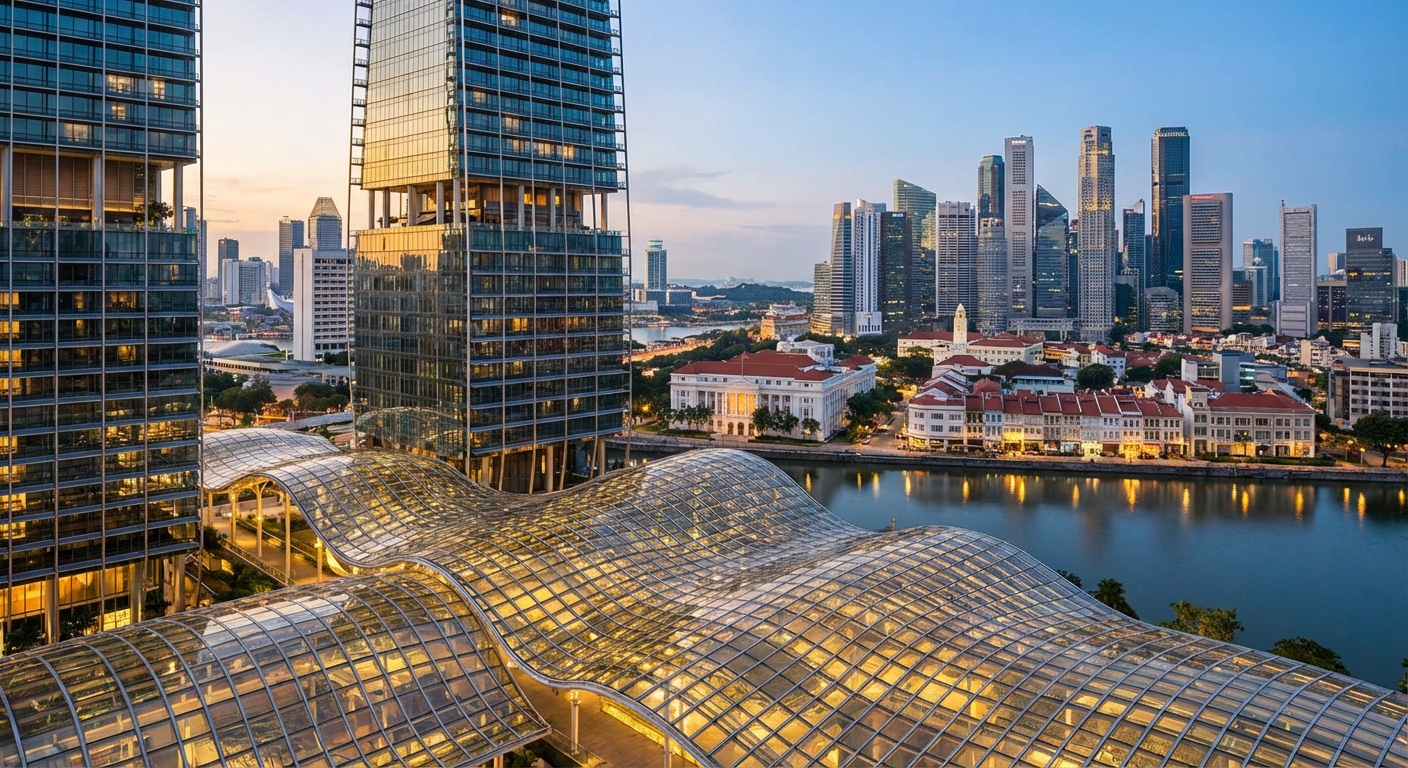
Walk through South Beach and you’ll notice something different. The light filters through in unexpected ways. The buildings curve and connect where most Singapore developments stand separate. This isn’t another glass tower district. South Beach represents a radical departure from typical tropical architecture, blending heritage conservation with cutting-edge design in ways that challenge how we think about urban spaces in Southeast Asia.
South Beach Singapore architecture distinguishes itself through its massive parametric canopy that covers 18,000 square meters, its integration of two heritage buildings into a modern complex, and its climate-responsive design that reduces energy consumption by 35%. The Foster + Partners design earned multiple awards for sustainability and innovation, setting new standards for tropical urban architecture in Singapore’s Beach Road precinct.
The Canopy That Changed Everything
The most striking feature of South Beach is the enormous flowing canopy that sweeps across the entire development. This isn’t decorative. The structure serves multiple environmental functions.
Designed using parametric modeling, the canopy consists of 654 unique steel sections and 6,700 aluminum panels. No two sections are identical. Each panel was calculated to optimize shade, ventilation, and light diffusion for the spaces below.
The canopy reduces heat gain by blocking direct sunlight while allowing natural ventilation. Air flows through the open sides and rises naturally, creating a microclimate that stays several degrees cooler than surrounding streets. This passive cooling system means less reliance on air conditioning in common areas.
At night, the underside glows with integrated LED lighting that changes based on events and seasons. The effect transforms the entire precinct into an illuminated public space visible from surrounding towers.
Heritage Buildings Meet Modern Engineering
South Beach incorporates two significant heritage structures: the former South Beach Development office and the old Beach Road Police Station. Both buildings date to the early 20th century and represent different architectural periods in Singapore’s history.
Rather than demolishing or isolating these structures, the architects integrated them into the new development. The heritage facades were preserved and restored while new towers rise behind them. Glass connectors link old and new, making the historical layers visible.
This approach contrasts sharply with typical Singapore redevelopment, where heritage buildings often stand alone as museums or restaurants, disconnected from surrounding modern structures. At South Beach, you move seamlessly from a 1920s colonial building into a contemporary hotel lobby.
The engineering challenge was substantial. The new towers required deep foundations, but excavation couldn’t destabilize the heritage structures. The solution involved underpinning the old buildings and using careful sequencing during construction.
Climate Responsive Design Features
South Beach was designed specifically for Singapore’s tropical climate, not adapted from a template used in cooler regions.
Key climate features include:
- Deep overhangs and vertical fins that block low-angle sun while admitting daylight
- Natural ventilation in all public areas, reducing mechanical cooling needs
- Rain gardens and bioswales that manage stormwater on-site rather than overwhelming drainage systems
- Green walls and rooftop gardens that reduce heat island effect
- High-performance glazing that blocks heat while maintaining transparency
The building orientation minimizes east and west facing glass, which would create intense heat gain in the tropics. Most windows face north or south with substantial shading devices.
These aren’t token green features added for certification. The entire building form responds to sun angles, prevailing winds, and rainfall patterns specific to Singapore’s location one degree north of the equator.
A Different Approach to Mixed Use Development
Most Singapore developments separate functions clearly. Office towers stand apart from hotels. Retail occupies ground floors. Residential towers cluster together.
South Beach mixes everything within a unified architectural language. The complex includes:
- Two office towers (South Beach Tower and Gateway)
- A luxury hotel (South Beach Hotel)
- Extensive retail and dining spaces
- Residential apartments
- Public plazas and event spaces
All these functions share the canopy and connect through landscaped pedestrian routes. You can live, work, eat, and shop without leaving the development, yet it never feels like an enclosed mall.
The ground plane remains open and permeable. Multiple entrances and pathways let you cut through the site rather than walking around it. This porosity is rare in Singapore developments, which typically create internalized environments.
Sustainability Beyond Green Certification
South Beach achieved Green Mark Platinum, Singapore’s highest sustainability rating. But the environmental performance goes beyond checklist compliance.
The development generates some of its own power through photovoltaic panels integrated into the canopy. Rainwater is harvested, treated, and used for irrigation and cooling tower makeup water. Waste heat from chillers preheats domestic hot water.
Energy consumption runs 35% below Singapore’s baseline for similar buildings. Water use is 45% lower than conventional developments.
These numbers matter because they prove tropical architecture can be both dramatic and efficient. The canopy isn’t just sculptural. It’s a functioning environmental control system that reduces operating costs while improving occupant comfort.
The Public Space Strategy
Unlike typical Singapore commercial developments that privatize ground level space, South Beach dedicates significant area to genuinely public use.
The main plaza hosts concerts, markets, and festivals. During major events, thousands of people gather under the canopy. The space accommodates this without feeling crowded because the canopy creates a sense of enclosure without walls.
Seating areas, water features, and landscaping invite people to linger rather than just pass through. Office workers eat lunch there. Tourists photograph the architecture. Families attend weekend events.
This activation of public space represents a shift in Singapore development thinking. Developers traditionally maximized leasable area. South Beach demonstrates that generous public space can enhance rather than diminish commercial value.
Architectural Awards and Recognition
South Beach collected numerous international architecture awards, including recognition from the Council on Tall Buildings and Urban Habitat, the International Architecture Awards, and multiple Green Building Council honors.
The development appeared in architecture publications worldwide as an example of climate-responsive design and heritage integration. It’s now regularly included in architectural tours and university curricula as a case study.
| Award Category | Recognition | Significance |
|---|---|---|
| Sustainability | Green Mark Platinum | Highest Singapore environmental rating |
| Design Excellence | International Architecture Award | Global recognition for innovation |
| Urban Integration | CTBUH Award of Excellence | Acknowledged contribution to urban fabric |
| Heritage Conservation | URA Architectural Heritage Award | Successful integration of historic structures |
These aren’t participation trophies. The awards reflect genuine innovation in solving tropical architecture challenges that most developments ignore.
Comparing South Beach to Typical Singapore Architecture
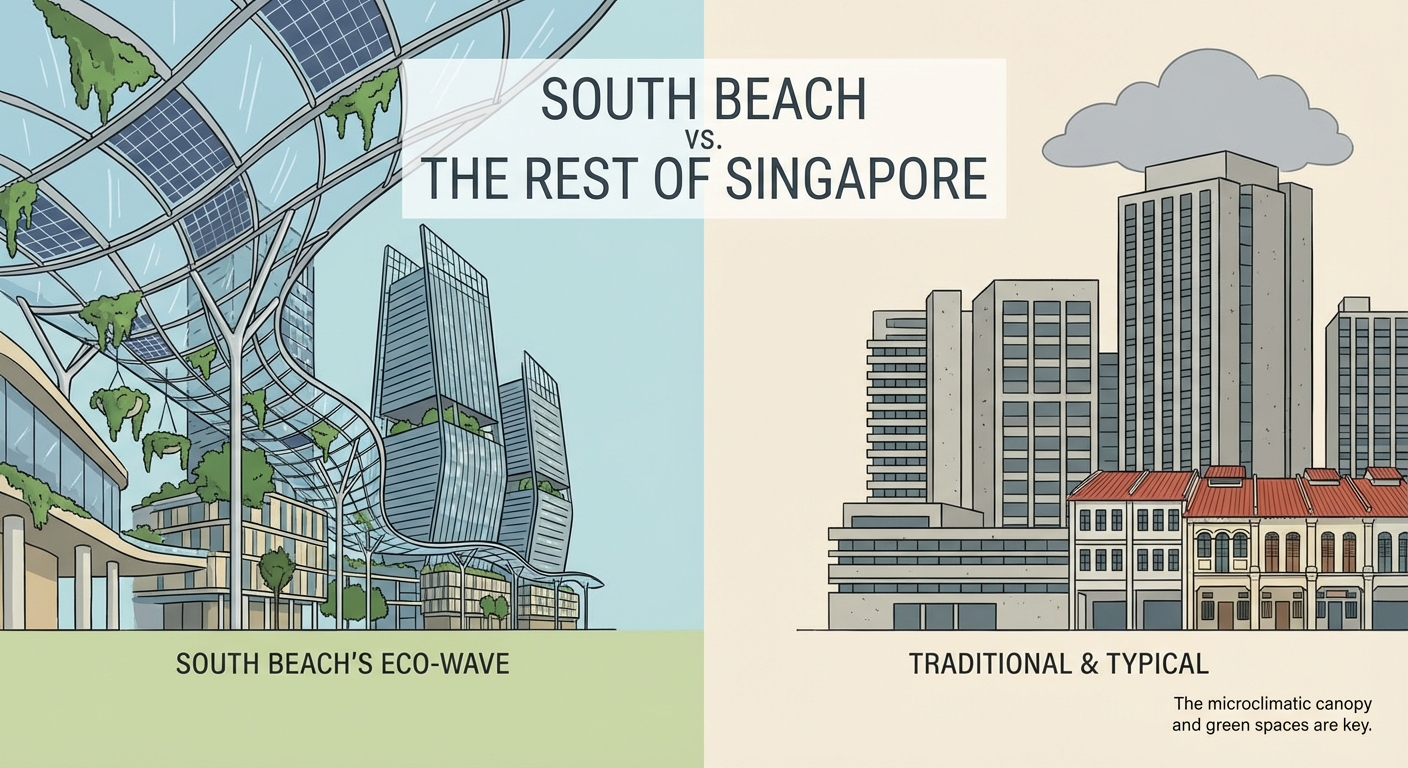
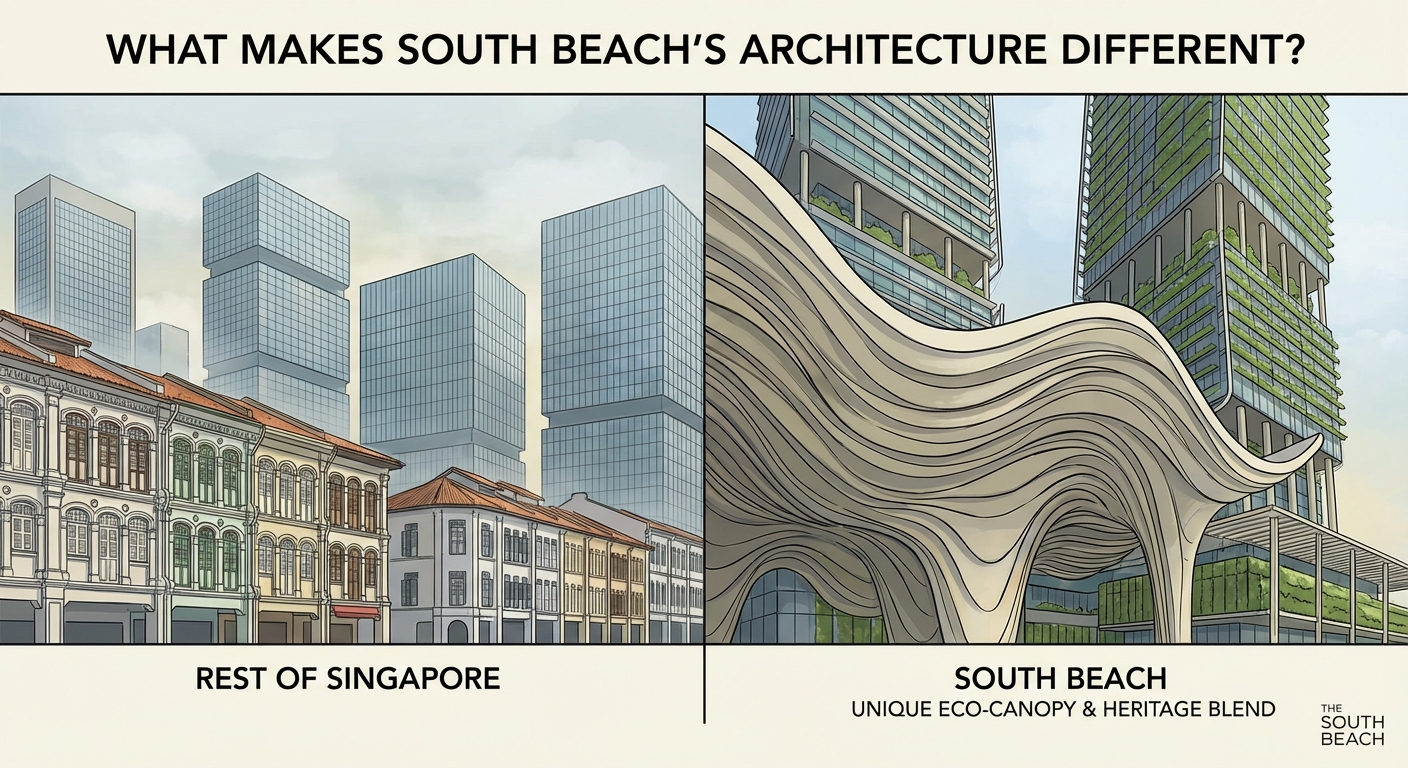
Standard Singapore commercial architecture follows predictable patterns. Rectangular towers. Fully sealed glass facades. Internalized air-conditioned spaces. Minimal public areas.
South Beach breaks every convention:
Standard approach: Maximize floor plates for efficiency
South Beach: Sculpt building forms to optimize environmental performance
Standard approach: Seal buildings against tropical climate
South Beach: Work with climate through passive strategies
Standard approach: Separate heritage and modern elements
South Beach: Integrate old and new into unified design
Standard approach: Privatize valuable ground level space
South Beach: Create generous public realm
The difference is philosophical. Most developments treat Singapore’s climate as a problem to overcome with engineering. South Beach treats it as a design driver that shapes architectural form.
Technical Innovation in Construction
Building South Beach required construction techniques uncommon in Singapore. The canopy’s complex geometry meant every structural connection was unique. Traditional construction methods couldn’t handle this complexity.
The solution involved Building Information Modeling (BIM) at a level of detail rarely used in 2016 when construction completed. Every canopy element was modeled digitally, fabricated with CNC precision, and assembled on-site with minimal adjustment.
Structural elements arrived with QR codes linking to their exact position in the digital model. Workers scanned codes and followed augmented reality guides for installation. This digital fabrication approach is common now but was pioneering for Singapore at that time.
The result is a structure that looks organic but required extreme precision. Tolerances measured in millimeters across spans of hundreds of meters.
“South Beach demonstrates that sustainability and architectural ambition aren’t competing goals. The most environmentally responsive solution often produces the most compelling architecture. The canopy performs its environmental functions because of its form, not despite it.” – Architecture critic reviewing the completed development
How the Design Influences Daily Experience
Architecture criticism often focuses on aesthetics or technical achievement. But what matters most is how design affects the people who use spaces daily.
Office workers at South Beach report higher satisfaction with their workplace environment compared to conventional towers. Natural light penetrates deeper into floor plates. Views extend in multiple directions. Fresh air reaches common areas.
Hotel guests photograph the canopy from their rooms. The structure frames views rather than blocking them. At night, the illuminated underside creates ambiance that typical hotel towers can’t match.
Retail tenants benefit from foot traffic drawn by the public spaces. People come to experience the architecture and stay to eat or shop. The environment encourages lingering rather than efficient transactions.
Residents in the towers enjoy amenities and dining options without the isolation typical of residential-only developments. The mixed-use program creates activity at all hours.
Lessons for Future Singapore Architecture
South Beach proved several concepts that seemed risky during planning:
- Large-scale public space can enhance commercial value
- Heritage integration strengthens rather than compromises new development
- Climate-responsive design reduces costs while improving experience
- Architectural ambition attracts tenants and drives premium rents
These lessons influenced subsequent Singapore projects. More developments now incorporate generous public space. Heritage integration has become more sophisticated. Climate-responsive features appear beyond token green walls.
The project demonstrated that Singapore architecture could move beyond efficient but generic towers toward designs with strong identity rooted in place and climate.
What Makes It Specifically Singaporean
Despite being designed by international architects Foster + Partners, South Beach feels distinctly Singaporean in ways that go beyond meeting local codes.
The design responds to Singapore’s specific latitude, rainfall patterns, and urban density. The canopy form evolved from analysis of sun angles at 1.3 degrees north. The ventilation strategy accounts for Singapore’s prevailing winds. The stormwater management reflects local rainfall intensity.
The integration of heritage buildings acknowledges Singapore’s complex relationship with its past. The development doesn’t sentimentalize history but brings old structures into active contemporary use.
The mixed-use program reflects how Singaporeans actually live, blending work, home, and leisure in ways that suburban-style separation doesn’t accommodate.
The public space design accounts for Singapore’s outdoor event culture, creating venues for the festivals and gatherings that punctuate the local calendar.
Architecture That Performs
South Beach Singapore architecture succeeds because form and function align completely. Every dramatic gesture serves practical purposes. The sweeping canopy isn’t applied decoration but an integrated environmental control system. The heritage integration isn’t nostalgic preservation but active reuse. The public spaces aren’t leftover areas but carefully designed social infrastructure.
This integration of aesthetics and performance sets South Beach apart from typical Singapore developments where these elements often compete. The result is architecture that looks distinctive while working better than conventional alternatives. That combination explains why the project attracted international attention and influenced subsequent Singapore development. The buildings prove that responding to local climate and culture produces more interesting architecture than importing generic international styles. Walk through South Beach and you experience architecture designed for exactly where it stands, performing exactly as intended.