 By eric
 Singapore’s South Beach district stands as a living museum where colonial grandeur meets contemporary design. The neighborhood preserves some of the city’s most significant heritage buildings, each telling stories of British colonial rule, military history, and architectural evolution spanning nearly two centuries.
South Beach’s colonial heritage buildings showcase British military architecture from the 1800s. The district features four major structures: the Old Beach Road Police Station, Raffles Hotel Arcade, South Beach Tower integration, and Fort Canning’s military installations. These buildings blend Victorian, Edwardian, and Art Deco styles with modern preservation techniques, creating Singapore’s most accessible architectural heritage zone.
Understanding South Beach’s Architectural Timeline
The area now known as South Beach began as military grounds in the 1820s. British colonial planners positioned barracks, administrative buildings, and defense structures along the coastline, which has since moved due to land reclamation.
Three distinct periods shaped the architecture you see today.
The early colonial period (1820s to 1860s) brought utilitarian military buildings. These structures used thick walls, high ceilings, and deep verandahs to combat tropical heat. The British Army Engineers designed them for function over form.
The Victorian era (1860s to 1900s) introduced ornamental elements. Cast iron columns, decorative plasterwork, and colored tiles appeared on government buildings. This period reflected Britain’s growing confidence as a colonial power.
The Edwardian and inter-war period (1900s to 1940s) added Art Deco influences. Buildings featured streamlined geometry, pastel colors, and modern materials like reinforced concrete.
The Four Heritage Anchors
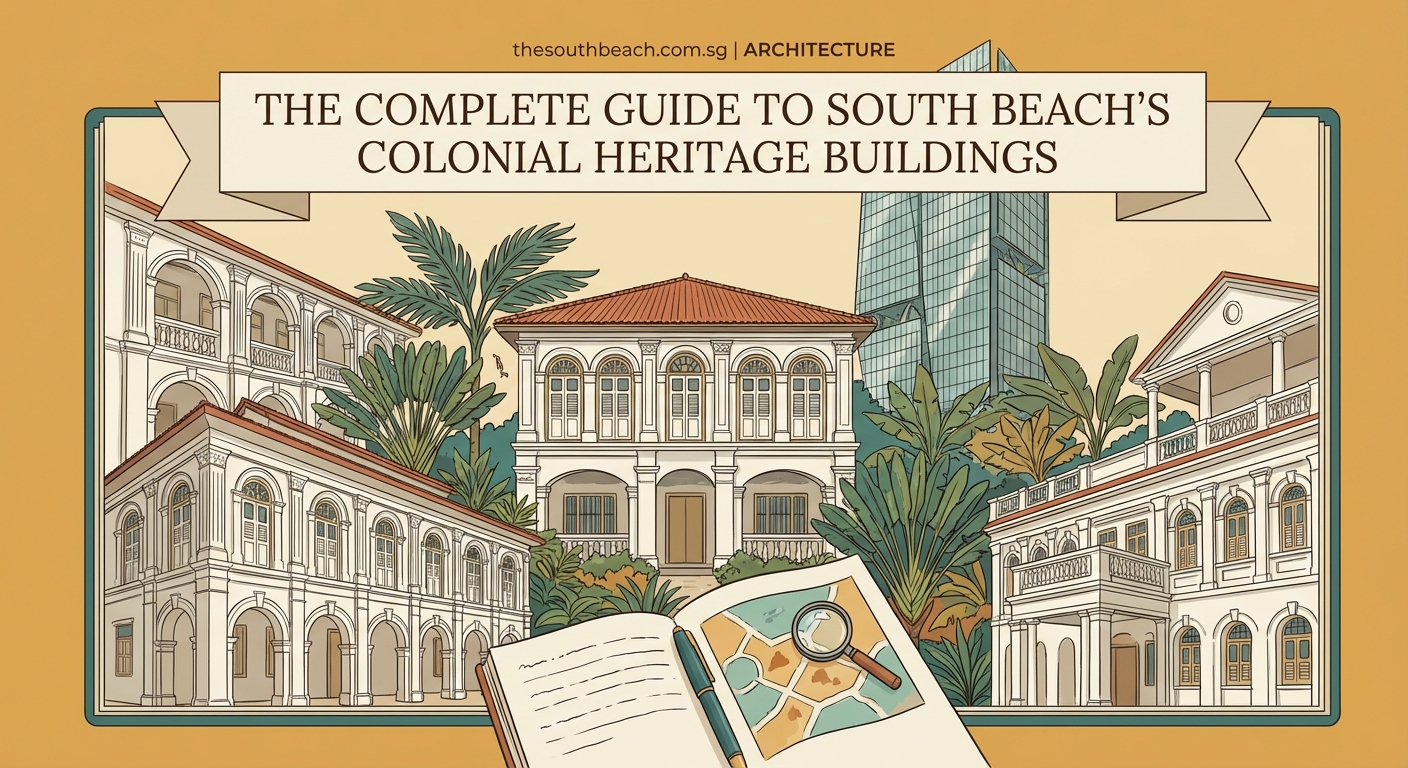
Old Beach Road Police Station
Built in 1934, this Art Deco structure served as Singapore’s central police headquarters until 2001. The building displays classic Art Deco features: stepped parapets, geometric window patterns, and a symmetrical facade.
The architects used reinforced concrete, then a cutting-edge material. This allowed larger windows and more open floor plans than traditional masonry construction.
Look for the vertical emphasis in the design. The building rises five stories, unusual for 1930s Singapore. Vertical pilasters create a sense of height and authority appropriate for a police headquarters.
The structure now forms part of the South Beach development, with the heritage facade preserved while the interior was completely rebuilt.
Raffles Hotel Arcade
Constructed in 1989 but incorporating Victorian design elements, the arcade connects to the legendary Raffles Hotel complex. The arcade features cast iron columns, terrazzo floors, and shophouse-inspired proportions.
The design references Singapore’s late 19th-century commercial architecture. High ceilings promote air circulation. Wide covered walkways protect pedestrians from sun and rain.
The arcade demonstrates adaptive heritage design. Modern retail needs blend with historical architectural language.
South Beach Tower Integration
This 2016 development shows how contemporary architecture can honor colonial heritage. The tower rises behind preserved colonial facades, creating a dramatic contrast between old and new.
French architect Jean Nouvel designed the integration. His approach: preserve the street-level heritage experience while adding modern density above.
The project retained original walls, columns, and decorative elements. New construction begins above the heritage rooflines, making the old buildings appear complete from street level.
Fort Canning Military Structures
Located adjacent to South Beach, Fort Canning Hill contains numerous colonial military buildings. The Fort Gate, built in 1859, marks the original entrance to the military cantonment.
The Gothic Revival gate features pointed arches and crenellations. These design choices referenced medieval European fortifications, projecting British military power in visual form.
Other structures on the hill include the former barracks, now converted to cultural facilities, and underground bunkers from World War II.
Architectural Styles Decoded
| Style | Period | Key Features | Example in South Beach |
|---|---|---|---|
| Victorian Colonial | 1860s-1900s | Cast iron details, high ceilings, verandahs | Raffles Hotel complex |
| Edwardian | 1900s-1910s | Red brick, white trim, symmetrical facades | Fort Canning structures |
| Art Deco | 1920s-1940s | Geometric patterns, vertical emphasis, pastel colors | Old Beach Road Police Station |
| Contemporary Heritage | 2000s-present | Glass towers behind preserved facades | South Beach Tower |
Each style responded to specific needs and technologies.
Victorian colonial buildings prioritized natural ventilation. Before air conditioning, architects used cross-ventilation, high ceilings, and shaded walkways to create comfortable interiors.
Edwardian structures introduced modern plumbing and electrical systems. You can spot this period by the addition of service rooms and utility spaces.
Art Deco buildings embraced reinforced concrete and steel frames. This allowed larger windows and more flexible interior layouts.
Contemporary preservation projects use climate control and modern building systems while maintaining historical appearances.
Self-Guided Walking Route
Start your architectural tour at the Old Beach Road Police Station. This gives you immediate context for Art Deco colonial design.
- Begin at the corner of Beach Road and Purvis Street
- Walk the perimeter of the Old Beach Road Police Station to see all four facades
- Enter the South Beach complex through the preserved heritage entrance
- Walk through the ground floor to see the integration of old and new
- Exit onto Bras Basah Road and turn right toward Raffles Hotel
- Walk through the Raffles Hotel Arcade to see Victorian-inspired retail design
- Continue to Fort Canning Park entrance
- Climb the hill to see the Fort Gate and military structures
This route covers approximately 1.5 kilometers and takes 90 minutes at a leisurely pace with stops for photography.
What to Look For
Architectural details reveal construction methods and design priorities.
Foundation and walls: Colonial buildings used thick masonry walls for structural support and thermal mass. The walls stay cool during the day and release heat slowly at night.
Windows and shutters: Look for tall, narrow windows with wooden shutters. These allowed ventilation while maintaining privacy and security.
Roofing: Clay tiles were standard. The steep pitch shed tropical rain effectively. Overhanging eaves protected walls from water damage.
Columns: Cast iron columns appear throughout Victorian buildings. Britain shipped these prefabricated elements to Singapore. Each column bears manufacturer marks if you look closely.
Decorative elements: Plasterwork, tiles, and carved wood show the building’s status. Government buildings received elaborate decoration. Utilitarian structures remained plain.
“Colonial architecture in Singapore wasn’t just about aesthetics. Every design choice addressed practical challenges: heat, humidity, heavy rain, and termites. The buildings that survive today succeeded because they solved these problems elegantly.” – Conservation architect speaking about South Beach heritage buildings
Photography Tips for Architecture Enthusiasts
Morning light (7am to 9am) provides the best conditions for photographing South Beach’s heritage buildings. The low angle sun creates definition and brings out architectural details.
Afternoon light works for buildings facing west, particularly the Old Beach Road Police Station’s main facade.
Avoid midday photography. Harsh overhead sun creates unflattering shadows and washes out colors.
For interior shots in public areas:
– Use a wide-angle lens to capture full spaces
– Look for natural light sources like windows and skylights
– Shoot from corners to show spatial relationships
– Include people for scale and context
For facade photography:
– Step back to capture the full building
– Use vertical lines in your composition
– Include surrounding context
– Photograph details separately (columns, windows, decorative elements)
Common Misconceptions About Colonial Architecture
Many visitors assume all colonial buildings look similar. The reality shows significant variation based on period, function, and architect.
Misconception: Colonial buildings are all white.
Reality: Many colonial structures featured colored plasterwork, painted timber, and decorative tiles. White became standard only in later restoration projects.
Misconception: The British designed all colonial buildings.
Reality: Local architects, Chinese builders, and Indian craftsmen contributed significantly. Many “colonial” buildings blend European design concepts with Asian construction techniques.
Misconception: Heritage buildings must remain frozen in time.
Reality: Successful preservation adapts buildings for contemporary use. South Beach demonstrates how heritage facades can integrate with modern development.
Preservation Techniques You Can Observe
South Beach’s heritage buildings showcase various preservation approaches.
Facade retention: The Old Beach Road Police Station kept its exterior walls while completely rebuilding the interior. New steel frames support the heritage facade independently from the modern structure behind.
Material matching: Restoration work used traditional materials where possible. New plasterwork matches original formulations. Replacement tiles came from the same manufacturers when available.
Reversible interventions: Modern additions use techniques that allow future removal without damaging historic fabric. Steel brackets attach to original walls without penetrating deep into the masonry.
Climate control: Modern HVAC systems maintain stable temperature and humidity, protecting historic materials from tropical climate damage.
Best Times to Visit
South Beach’s heritage buildings remain accessible year-round, but timing affects your experience.
Weekday mornings (Tuesday to Thursday, 8am to 11am) offer the quietest conditions. You can photograph buildings without crowds and examine details closely.
Weekend afternoons bring more activity but also more vibrant street life. The contrast between historic architecture and contemporary use becomes more apparent.
Avoid public holidays and major events. The area becomes crowded, making photography and detailed observation difficult.
Singapore’s dry season (February to April) provides the most reliable weather for extended walking tours.
Connecting Architecture to Singapore’s History
Each building in South Beach connects to broader historical narratives.
The military structures reflect Singapore’s strategic importance as a British naval base. The fortifications and barracks housed troops who defended maritime trade routes.
The police station represents colonial law enforcement. The imposing Art Deco design projected authority and modernity during a period of social change.
The integration of heritage buildings into contemporary development shows Singapore’s approach to urban planning. The city values both preservation and progress, seeking balance between past and future.
Resources for Deeper Learning
Several organizations offer additional information about South Beach’s architectural heritage.
The Urban Redevelopment Authority maintains detailed records of conservation buildings. Their online database includes historical photographs, architectural drawings, and preservation guidelines.
The National Heritage Board conducts regular heritage tours. These guided walks provide expert commentary on architectural features and historical context.
The Singapore Institute of Architects library contains archival materials about colonial-era architects and construction methods.
Making the Most of Your Visit
Preparation enhances architectural appreciation.
Before visiting:
– Research specific buildings that interest you
– Download walking maps
– Check weather forecasts
– Charge camera batteries
During your visit:
– Take notes on architectural details
– Photograph from multiple angles
– Compare different buildings’ approaches to similar challenges
– Observe how people use the spaces today
After your visit:
– Review your photographs and notes
– Research unfamiliar architectural terms
– Compare South Beach buildings to other colonial architecture in Singapore
– Share your observations with other architecture enthusiasts
Where Heritage Meets Modern Singapore
South Beach proves that architectural heritage and urban development need not conflict. The district shows how thoughtful design can preserve historical character while meeting contemporary needs.
The colonial buildings anchor the neighborhood’s identity. Their solid presence provides continuity amid rapid urban change. Yet these aren’t museum pieces. Shops, restaurants, and offices fill the preserved structures, keeping them active and relevant.
This living heritage approach makes South Beach special. You’re not observing architecture behind barriers. You’re experiencing buildings as their designers intended, as functional parts of urban life. The colonial architects built for permanence, and their work endures not just as historical artifacts but as usable, beautiful spaces that continue serving Singapore’s residents and visitors.
Walk these streets with attention to detail. Notice how light plays across Art Deco facades. Feel the cool shade under Victorian verandahs. Observe the craftsmanship in decorative elements. Each building rewards careful observation, revealing layers of history, technique, and human creativity frozen in brick, plaster, and stone.