 By eric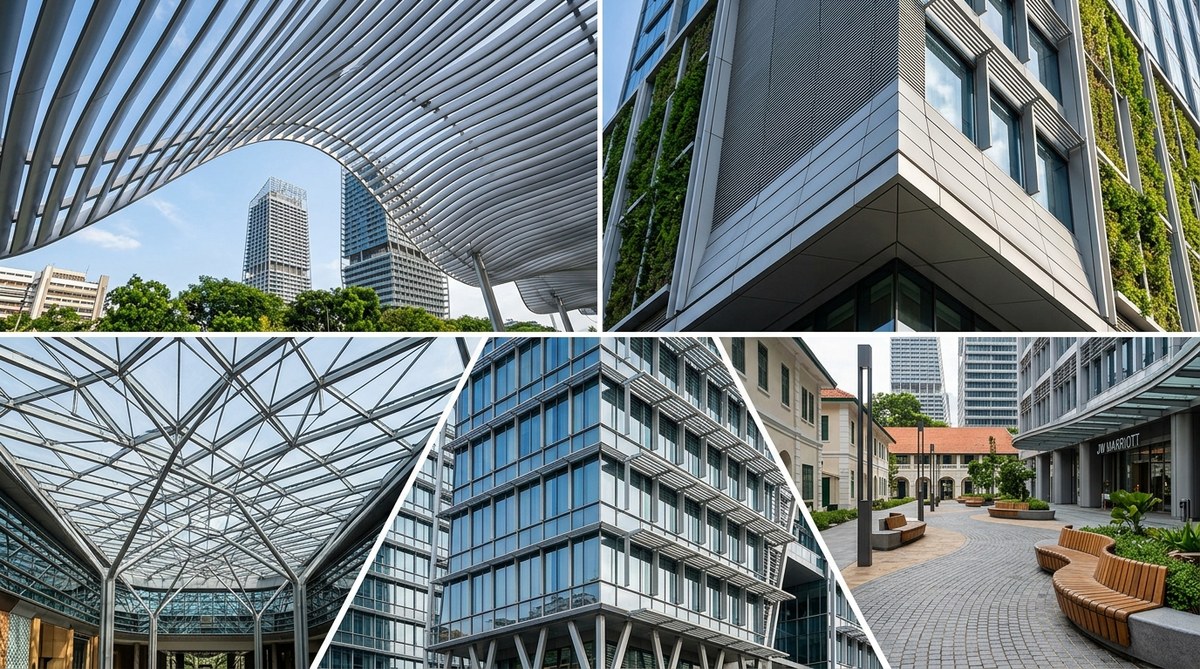
You have walked through the gleaming atrium of South Beach, snapped a photo of the iconic skybridge, and maybe grabbed a coffee at one of its trendy cafes. But did you notice the intricate mortar joints on the restored colonial facades? Or the way the tropical breeze flows through the cantilevered canopy? Most visitors rush past these subtle details. Let’s fix that.
South Beach Singapore is more than a glossy mixed-use development. Its architecture hides a careful dialogue between preserved colonial buildings and Foster + Partners’ modern vision. By training your eye on mortar joints, cooling canopies, river-washed granite, passive skybridge design, and integrated water features, you will unlock the real story of this landmark. These five details are the ones locals love and tourists miss.
The Quiet Conversation Between Old and New
South Beach was not built on a blank slate. The site once held a row of colonial bungalows and a military barracks. Instead of tearing them down, the architects kept them. They stitched the new 150,000 square meter development around these heritage structures. The result is a campus where glass towers rise behind preserved facades, and a public plaza flows through both worlds. This intention is the first thing to notice: the old buildings are not isolated museum pieces. They are living parts of the complex, housing restaurants, bars, and retail. If you stand at the center of the plaza and turn slowly, you will see the contrast. The warm brick and tropical verandahs of the past sit beside the cool steel and glass of the present. That tension is the soul of South Beach.
Most visitors walk right past the restored columns, never noticing the careful brickwork or the mortars that mimic 19th century techniques. Let’s slow down.
Five Architectural Details Most Visitors Miss
1. Mortar Keys and Colonial Brick Restoration
Walk up to any of the conserved buildings. Look closely at the brick joints. They are not uniform. The masons hand-applied a special lime-based mortar to match the original 1800s mix. They even added “keys” small indentations in the mortar lines that catch light and shadow. This technique gives the walls texture and depth. Modern brick walls are smooth and flat. South Beach’s colonial walls feel tactile. When rain hits them, the lime mortar releases a faint earthy smell. That is a detail you cannot get from a photo.
2. The Cantilevered Canopies That Cool the Ground
Look up at the massive overhangs extending from the modern towers. They are not just decoration. Each canopy is angled to block direct sunlight from hitting the plaza from 10 a.m. to 4 p.m. The underside is lined with perforated metal that lets hot air escape. On a sunny afternoon, you will feel a temperature drop of several degrees as you walk under them. Architects call this passive shading. Most visitors just see a roof. Now you know it is a climate machine.
3. River-Washed Granite and Terracotta Accents
The plaza paving is not ordinary concrete. It is river-washed granite aggregate, sourced from Malaysia. The surface has a soft, irregular speckle that hides scuffs and reflects light gently. Contrast that with the terracotta rain screens on the tower facades. These clay fins are arranged in vertical bands that catch the sun differently throughout the day. In the morning they glow orange; in the afternoon they appear brown. The color shift is subtle. Most people never notice it because they are looking at their phones.
4. The Skybridge Structural Design and Passive Cooling
The skybridge connecting the two towers is often photographed for its sweeping views. But look at the underside. The bridge is not a solid beam. It is a truss structure with open gaps that allow wind to pass through. This prevents the bridge from acting like a wind tunnel. On windy days, you can stand on the bridge and feel the breeze slow down rather than speed up. The engineers also designed the bridge to sway slightly, absorbing seismic energy. If you stand still for a minute, you might feel a gentle 1 movement. That is intentional.
5. Water Features That Manage Rainwater
Next to the preserved bungalows, you will see shallow reflecting pools. They are not just decorative. They collect rainwater from the roofs and drain it into underground cisterns. That water is then used to irrigate the gardens and flush toilets. The water level in the pools rises during a storm and drops during dry spells. Watch the edge of the pool after a rain shower. You will see trickle channels that slow the water down, preventing erosion. Most visitors splash their hands in the pool and move on. Now you know it is a visible piece of the building’s green infrastructure.
Quick Tips for Spotting These Details
- Visit at different times of day. The light changes the terracotta and granite colors.
- Stand under the canopies for 30 seconds and feel the temperature difference.
- Look at the mortar lines on the colonial buildings from a few inches away.
- Walk the skybridge slowly, especially on a windy afternoon.
- Check the water level in the reflecting pools before and after a rain shower.
Mistakes to Avoid When Appreciating South Beach Architecture
| Mistake | Expert Approach |
|---|---|
| Only looking at the tall towers | Focus on the ground level details first |
| Visiting only at noon when shadows are flat | Come early morning or late afternoon for textured shadows |
| Ignoring the colonial buildings | Spend 10 minutes examining the brickwork and verandahs |
| Rushing through the plaza | Sit on a bench and watch how people interact with the space |
| Assuming all the concrete is the same | Notice the difference between polished concrete inside and river-washed granite outside |
“The best architecture reveals itself slowly. At South Beach, the real story is in the joints, the shadows, and the way water moves. Most people see the headline. The details are the footnotes that make the story true.”
— Lim Siew Kim, architectural conservator and former URA consultant
How to Plan Your Architectural Walk
You do not need a guided tour to catch these details. Here is a simple process.
- Start at the Esplanade MRT exit. Walk toward the conserved bungalows along Beach Road. Keep your eyes on the brickwork.
- Circle the plaza counterclockwise. This will bring you under both main canopies over 15 minutes.
- Pause at the reflecting pool near the heritage building. Watch the water for one full minute.
- Take the escalator to the skybridge level. Stand at the midpoint for 30 seconds and feel the breeze.
- End at the public art installation near the hotel lobby. The sculpture echoes the truss lines of the skybridge.
This walk takes about 40 minutes. You will see more than 90 percent of visitors ever notice. For the best light, come between 9 a.m. and 11 a.m. or 3 p.m. and 5 p.m.
If you want to photograph these details, check out our guide to the best Instagram-worthy spots in South Beach Singapore. For a longer visit, read how to spend a perfect afternoon at South Beach.
Why These Details Matter for Your Visit
Architecture is not just about how a building looks. It is about how it feels, how it ages, and how it responds to its climate. South Beach succeeds because it respects both the past and the tropical environment. The mortar keys, the cooling canopies, the granite paving, the truss bridge, and the rainwater pools are not accidents. They are choices that reward attention.
Next time you walk through South Beach, slow down. Look at the joints. Feel the air. Watch the water. Those details are the real South Beach. And now you know where to find them.